Your Cart is Empty


There is not one lesbian flag. There are several, each with its own origin story, its own community debates, and its own place in the ongoing conversation about what it means to represent lesbian identity visually. Some flags are widely adopted. Some are contested. Some carry historical weight that makes them complicated to fly. Understanding the lesbian flag colours means understanding something real about how queer communities negotiate identity, inclusion, and history in public. This is that guide.
The flag most widely used to represent lesbian identity today is the seven-stripe sunset flag, designed by Emily Gwen in 2018. It was created specifically to represent the full spectrum of lesbian experience: not femme, not butch, but both, and everyone in between. It was also explicitly designed to include trans lesbians and non-binary lesbians, which is part of why it gained such broad adoption.
The flag exists in two versions: a seven-stripe original and a five-stripe simplified version. Both use the same colour palette.

The seven stripes, from top to bottom, represent:

The five-stripe version condenses the flag by removing the orange 'independence' stripe and the dusty pink 'love and sex' stripe. It is often used where a simpler design is needed. Some in the community associate the removal of the 'love and sex' stripe with a nod to asexual and aromantic lesbians.

Before the sunset flag became dominant, the most recognisable lesbian flag was the lipstick lesbian flag: seven shades of pink and red with a white stripe, and a lipstick kiss mark in the upper left corner.
It was created in 2010 by blogger Natalie McCray on her blog This Lesbian Life. The intention was to represent femme-presenting lesbians specifically, particularly those who identified as 'lipstick lesbians': women who present in traditionally feminine ways while being exclusively attracted to other women.
The flag fell significantly out of favour for two reasons. First, it represented only one expression of lesbian identity, making it exclusionary by design. Second, McCray was later criticised for comments widely described as racist, transphobic, and biphobic. For many in the community, those associations made the flag impossible to use in good conscience. The sunset flag emerged partly in response to these limitations.

Separate from the lipstick flag, a plain pink lesbian flag exists: the same gradient of pinks, reds, and white, but with no kiss mark and no connection to McCray. Its original creator is unknown. It first appeared around 2015, likely on DeviantArt, and gained traction in 2016 as lesbians who connected with the pink colour palette but wanted distance from the lipstick flag's associations adopted it as an alternative.
It is sometimes called the femme flag, and it functions as a quieter signal of femme lesbian identity. It does not carry the baggage of the lipstick version, and it predates the sunset flag's rise as the community standard.
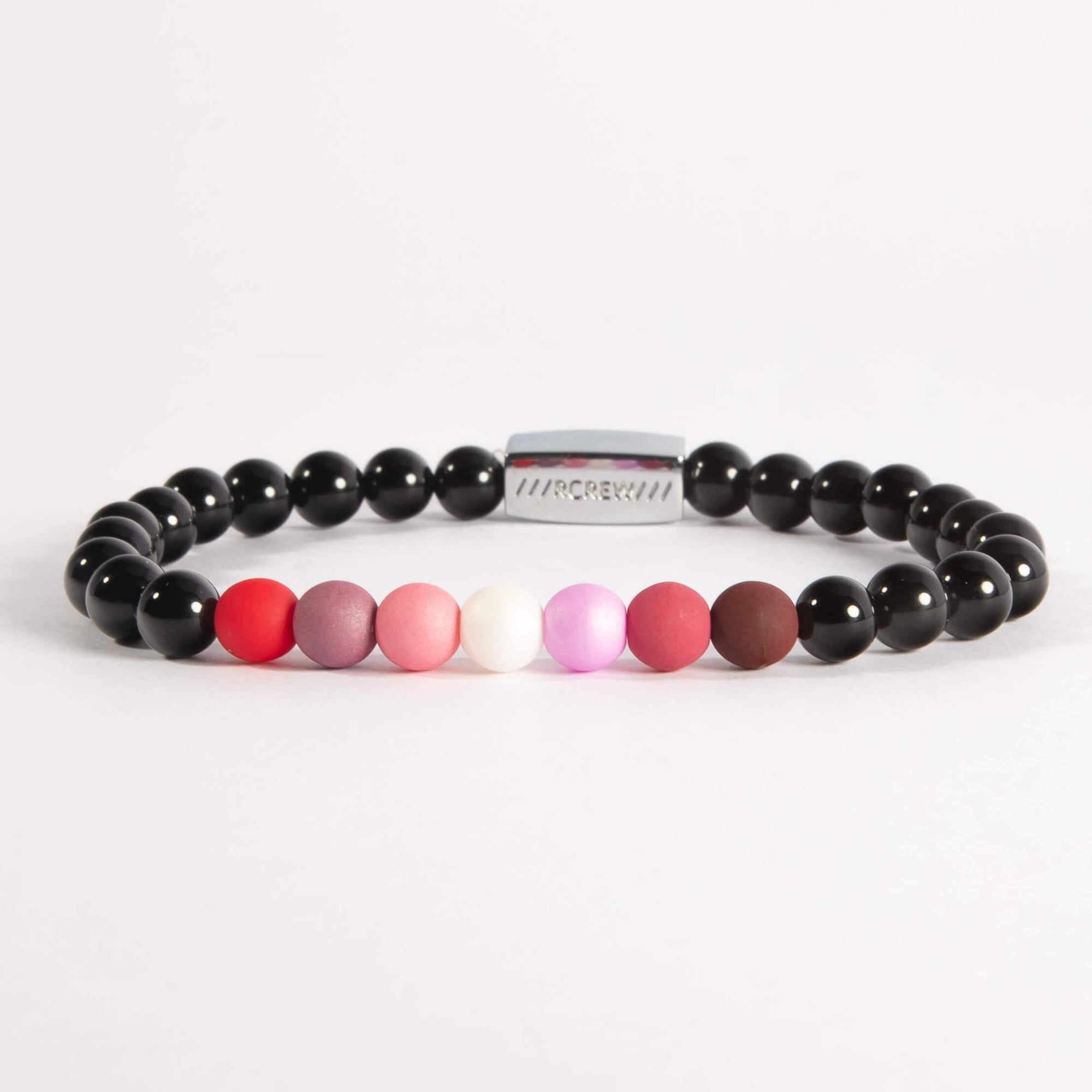
The RCREW bold pink lesbian bracelet reflects this flag: warm reds, pinks, and rose tones on a black base. To someone who doesn't know the flag, it reads as pink jewellery. To someone who does, it says something specific. Made by hand at Watford Workshop in Hertfordshire, a registered charity providing supported employment for people with disabilities.
Butch identity has its own flags, separate from the general lesbian flags. Two versions exist, and both emerged from Tumblr in the mid-2010s.

The orange butch flag has seven stripes in shades of orange, yellow, and brown. It was first shared in 2017 on the Tumblr blog butchspace, with detailed explanations for each stripe:
It is now the more widely recognised of the two butch flags, and the one you are most likely to see at Pride events and in community spaces.

The purple butch flag predates the orange version. It was created in 2016 by Tumblr user dorian-rutherford as a flag with a more deliberately masculine colour palette: varying shades of blue and purple with a white stripe. Its individual colours do not carry specific meanings in the way the orange flag's do; the intention was a visual aesthetic of masculinity rather than a symbolic breakdown. It has a smaller but faithful following, particularly among those who prefer its darker, more muted palette.

The labrys lesbian flag is the oldest of the lesbian flags, and the most complicated.
It was created in 1999 by Sean Campbell, a graphic designer, and published in the Gay and Lesbian Times, Palm Springs edition, Pride Issue, June 2000. (Yes, created by a man. The community has had opinions about this ever since.) The design does not use stripes. Instead, it centres a labrys (a double-headed axe associated with the Amazons of Greek mythology and later adopted by lesbian feminists in the 1970s) against an inverted black triangle on a deep violet background.
Each element carries meaning. The labrys is a symbol of female self-sufficiency and strength, rooted in mythology. The inverted black triangle references the symbol used by Nazi Germany to mark women considered 'asocial', which included lesbians: like the pink triangle before it, it has been reclaimed as a symbol of survival and resistance. The violet background references the ancient Greek poet Sappho, whose surviving poetry described love between women and who lent her name to the island of Lesbos and, eventually, to the word 'lesbian' itself.
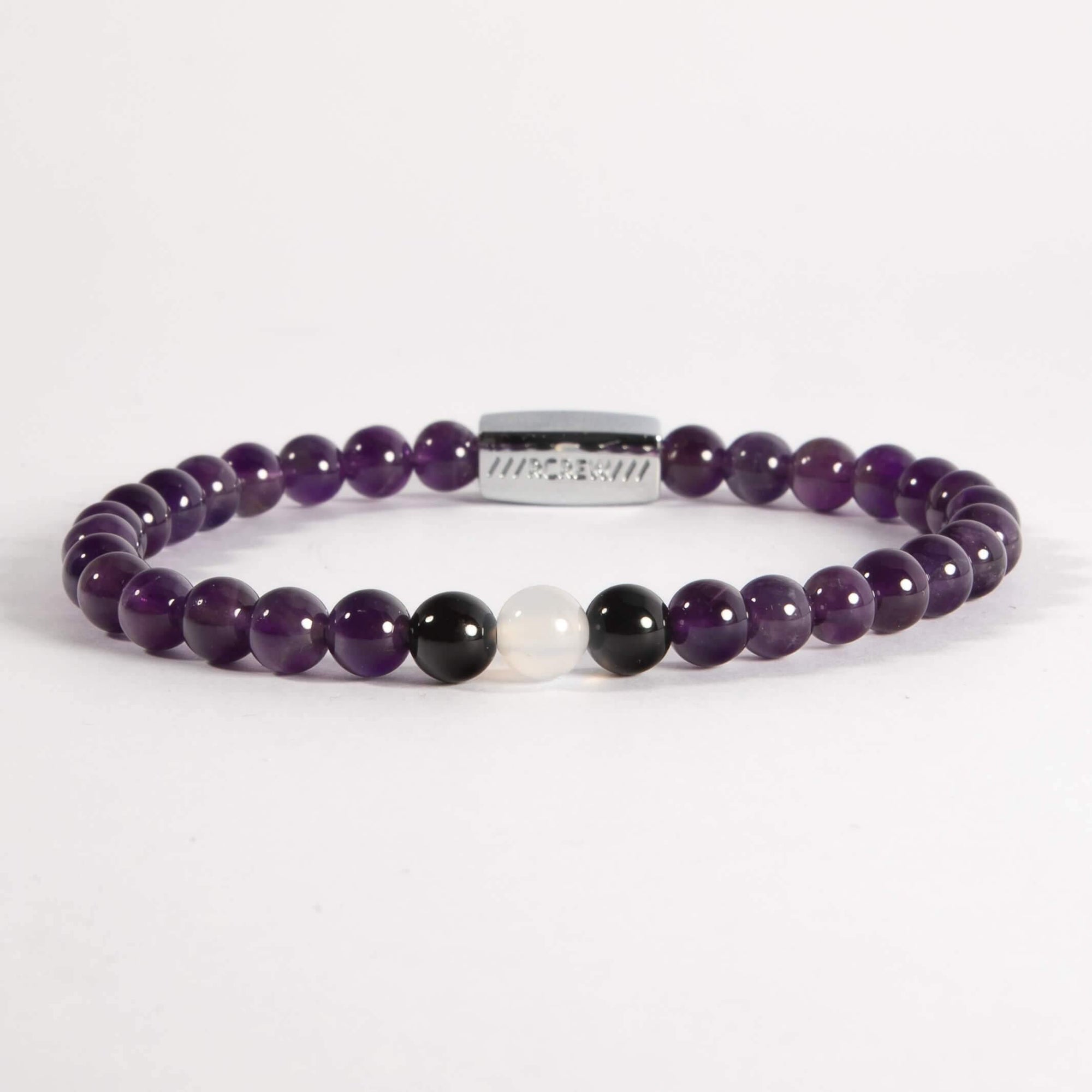
The RCREW semi-precious labrys bracelet is made in amethyst purple, black onyx, and white agate: the colours of the flag. Black for the inverted triangle, violet for Sappho, white for the labrys itself. It is worn by those who connect with butch identity, with the older traditions of lesbian feminism, and with the history the symbol carries. Made by hand at Watford Workshop in Hertfordshire, a registered charity providing supported employment for people with disabilities.
The flag's complicated modern history lies in its adoption by trans-exclusionary radical feminists (TERFs). Some TERF communities began using the labrys flag as a symbol specifically because its historical association with radical lesbian feminism aligned with an ideology that defines womanhood in ways that exclude trans women.
This has put non-TERF lesbians, particularly those with a long connection to the radical feminist tradition who hold no anti-trans views, in a difficult position. A symbol with genuine historical resonance for butch lesbians, masculine-presenting women, and those who identify with the older traditions of lesbian feminism has been claimed by a movement that actively harms trans women and trans lesbians.
The community response has not been uniform. Some lesbians have stepped back from the flag entirely, unwilling to use a symbol so visibly associated with trans exclusion in contemporary online spaces. Others have moved in the opposite direction: a deliberate, active reclamation. Their argument is that the flag belongs to the history it came from, that TERFs do not own the labrys or the traditions it represents, and that abandoning it concedes ground to an ideology that should not be rewarded with symbolic territory.
There is no settled answer. What is clear is that context matters: the labrys carries different weight depending on who is flying it and in what space. Many trans-inclusive lesbian communities use it with an explicit statement of that inclusion. Others prefer the sunset flag, which carries no such ambiguity.
The existence of several lesbian flags is not a problem to be resolved. It reflects something true about lesbian identity: it is not a single thing.
Butch and femme are not just aesthetics. Femme lesbians who spent years being told they were not visibly queer enough to count, and butch lesbians who faced discrimination not only for being gay but for failing to present femininity in ways society demanded, have different relationships to visibility and to signalling. Trans lesbians have fought for recognition within a community that has not always welcomed them.
Each flag carries a piece of that history. The debates about which to use are, in a real sense, debates about what the community is and who belongs in it. That is worth knowing, whether you are choosing a flag to fly, a colour to paint your nails, or a bracelet to wear.
All RCREW lesbian pride bracelets are made by hand at Watford Workshop in Hertfordshire, a registered charity providing supported employment for people with disabilities. We currently have two lesbian flags represented in the collection, with more planned. Browse the full collection.

Pride Month is built around love and sexual liberation. For asexual and aromantic people, that framing can make June feel like the loneliest month of all. Here is what that experience actually looks like, and what belonging means when the party was not designed with you in mind.

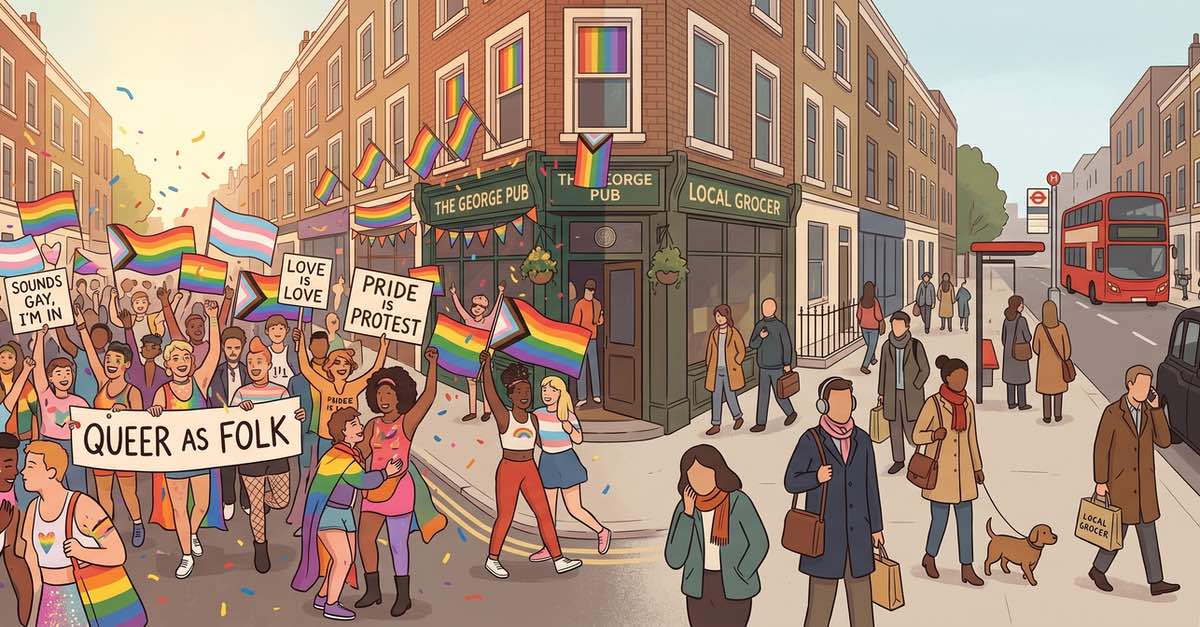
For a few hours every summer, the guesswork stops. You can look around and simply know. This is what Pride does that nothing else does. The question worth asking is what happens when it ends.

You and your people are in the same spaces every day. The same supermarkets, the same offices, the same commutes. The problem was never finding each other. It was knowing each other. And that is a different problem entirely.